Orlando Semi-Truck Accident Lawyers | Tina Willis Law Injury Accident Lawyer
After six years of relentless litigation, we recently reached a semi-truck accident settlement of $7 million. That was actually less than we wanted — and less than we believe we could have achieved. But our client needed the money. Pursuing more could have meant another decade of appeals, plus a second bad faith lawsuit with its own guaranteed appeal. At some point, the best thing I can do as an Orlando car and truck accident lawyer is get my client the money they need to live.
The first thing you need to know is that the insurance company absolutely did not want to pay. They fought hard for seven years, on nearly every point, doing everything possible to limit their exposure to the $1 million tractor trailer insurance policy. That was all they wanted to pay — ever.
Quick Summary: $1 Million to $7 Million in a Semi-Truck Accident Case
Catastrophic spinal cord injury from a semi-truck rear-end collision on a Florida interstate
Only a $1 million insurance policy, no other assets, and Florida’s legal presumption that the rear driver is at fault
Bad faith insurance claim, strategic venue selection, and a hand-picked trial team — including one of the top jury selection consultants in the country
Six years of litigation and over $1 million in costs advanced by our firm — at risk
$7 million settlement — seven times the insurance policy limit
How We Found Each Other
When I first met our client, his aunt had found me by searching Google, reading my reviews, and reading some of what I had written about our other cases. Something resonated with her. She knew that her very beloved nephew was sitting in a hospital room, needing real help — and would likely need a lot of help for the rest of his life. But she didn’t know who to call. Who would really, truly care about his interests and do the best for him?
I do think she was lucky to have found us. And I think we were lucky to have known the family — our lives are better for getting to know them.
Walking Into That Hospital Room
I walked into our client’s hospital room and found a man who was upbeat, positive, polite, and eager to engage. He had suffered an incomplete spinal cord injury, with paralysis from the chest down. He had some movement but almost no control of his arms, hands, legs, bladder, bowels, or feet. Yet he was smiling, happy to see me, respectful, curious about my life, and genuinely honored that I had driven from Orlando to Jacksonville to meet him in person.
This was right at the beginning of COVID. Our client was medically fragile and immunocompromised. His family was visiting without masks — even the hospital staff weren’t wearing N95s yet. So I brought a stack of them, gave them to him, and told him to please ask his family to wear them. It had nothing to do with his legal case. But he was vulnerable, and I wasn’t going to just not say something.
He told me what happened during the accident — at least what he could remember. He had rear-ended another truck, but he didn’t realize it was going so slow until it was too late to stop.
What happened next was the stuff of nightmares. The cab of his semi crashed into the trailer of another semi. He was driving just over 60 mph — the speed limit. The other trailer was on the interstate doing only 30 mph, which left almost no time for a fast-moving semi to stop before impact.
Our client was catastrophically injured. He had to be flown by a $50,000 life-flight helicopter to the nearest trauma center in Jacksonville.
After we talked for at least an hour, I tried to explain what would come next — how lawsuits work, why this would take time, and how we would try to help him. I’m not sure he fully understood the process that day, but I do think he felt a connection with me, trusted me, and believed that I had both the competence and compassion to truly help. I really liked him. I took his trust to heart — and left the hospital determined that we would do everything within our power to make sure he received the medical care and compensation he deserved.

The Slow Grind: What It Actually Takes to Fight for Someone
The following years were exactly that — a slow grind.
First, as we do with every case, we contacted all involved insurance companies, let them know we were involved, and requested the auto insurance policy declarations pages. This tells us how much insurance coverage the defendant carried — and begins to shape our strategy for how to recover the most money for our client.
We also started a two-part process immediately. First, we needed to gather and preserve all evidence, including retaining an expert to retrieve the black box data from the truck. Second, we needed to ensure our client was transported from Jacksonville back to a facility near his home in Atlanta that specialized in spinal cord injuries.
All of that eventually happened. Our client was treated for months at the Shepherd Center, one of the leading spinal cord injury treatment hospitals in the country. We had numerous conversations with the treatment coordinators there, making sure our client could get as much time under their care as possible — because their treatments were helping him regain functionality to the maximum extent possible.
The Human Side That Most People Never See
Eventually our client returned home — and life came at him fast. He had been estranged from his wife, who now seemed interested in whatever money he might recover. He needed to see his daughters. He needed money to live. He needed someone to care for him daily.
We felt like his only lifeline, but our hands were largely tied. Florida lawyers are ethically prohibited from advancing money to clients. Still, we knew he needed something. So we arranged for him to get a litigation loan — just enough to bridge the gap until he could access the benefits he would need to survive what none of us yet knew would be six years of waiting.
We also helped him find a divorce lawyer and advanced her fee as an additional cost from his eventual recovery. That divorce ultimately saved him from having his wife receive half of his award at the end of the case. [These are the kinds of decisions — invisible to most people — that can make or break what a client actually takes home.]
Throughout the case, we did our best to help him access ongoing treatment, and we explained the process to his family as often as they needed to hear it. During this time, I constantly felt terrible telling him that the semi-truck accident settlement process was just slow. But it was.
Building the Case: Experts, Evidence, and the Search for More Coverage
We ultimately hired numerous experts — a lifecare planner, an accident reconstructionist, several physicians, and someone to develop a special needs trust. That trust was the only mechanism through which our client, as a Medicaid recipient, could receive any money without losing his benefits.
We also searched exhaustively for additional defendant assets or other insurance policies. But there was no other policy. The defendants’ assets were nowhere near enough to cover the cost of our client’s lifetime care needs, let alone his pain and suffering.
The Crossroads: Where 99% of Lawyers Would Have Stopped
This is where the case reached its critical turning point.
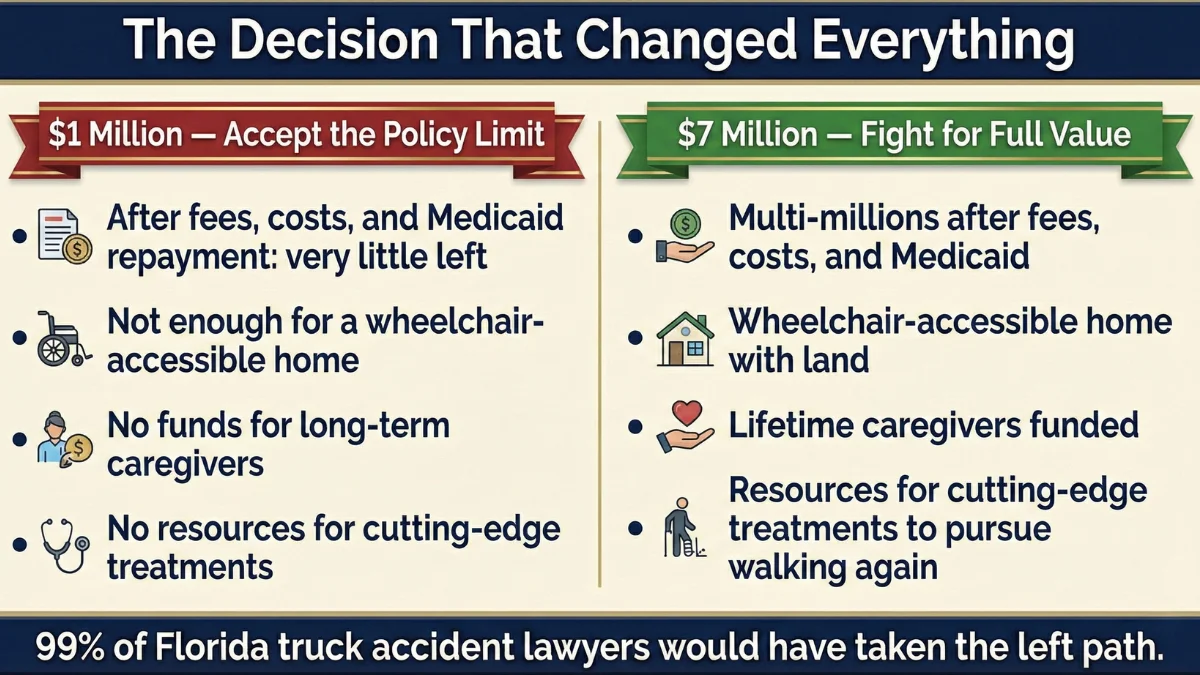
The insurance company had been offering $1 million for over a year — a semi-truck accident settlement at the full policy limit, and not a dollar more. There was no other money. No other insurance. At this point, we could have collected our fee, repaid his medical bills to Medicaid (as required by law), and explained to our client that there was simply no other money available.
From my experience, accepting that semi-truck accident settlement is exactly what 99.99% of Florida truck accident lawyers would have done. I’m not exaggerating.
We also considered offering to split our fee with our client — something we don’t normally do. But we knew that even that amount wouldn’t meaningfully change his life. Plus, any amount he received would need to go into a special needs trust, which has its own operating costs that would further dwindle whatever small amount we could give him.
Florida Law Was Stacked Against Us
Now I need to explain two legal principles that made this case especially difficult.
First, Florida courts have decisions governing rear-end accidents. If you run into the back of another vehicle, there is something called a “rebuttable presumption” that you caused the accident. That means you can try to argue otherwise, but the judge will instruct the jury to presume you were at fault. Then your lawyers have to overcome that presumption with evidence.
That’s a long way of saying that whenever you are the one who rear-ended another driver, were injured, and want to recover money — the legal burden is extremely high. Not impossible, but much more difficult than most accident cases.
Second, insurance companies in Florida are only required to pay more than their policy limits if they acted in “bad faith.” That means they failed to pay the full value of the claim when they could and should have.
Our Strategy: Bad Faith — and the Tactical Move That Made It Work
Bad faith was our plan to recover a semi-truck accident settlement that reflected the true value of our client’s injuries — far beyond that $1 million policy. But proving bad faith required us to demonstrate that the insurance company had every opportunity to resolve this claim fairly and chose not to. That required patience, strategy, and a deliberate decision that most lawyers would never make.
Here’s what we did — and didn’t do.
Most personal injury lawyers, when they believe a case is worth more than the insurance policy, will send a formal demand letter to the insurance company. That letter essentially says: “Your insured’s policy is $1 million. This case is worth far more than that. You need to pay the full policy now, or you’ll face a bad faith claim.” It’s standard practice. It’s what they teach you. And it’s exactly what we chose not to do.
Instead, we did something counterintuitive. We began methodically sending the insurance company every single piece of our client’s medical records and bills as we received them — without any demand. No letter telling them what they owed. No warning that they were exposing themselves to a bad faith claim. Just the raw evidence of how catastrophic our client’s injuries were, how extensive his treatment was, and how enormous his lifetime care needs would be.
Why? Because we aren’t required to demand that they pay. The insurance company has an independent duty to evaluate the claim based on the information available to them and offer the policy limits when the value clearly exceeds those limits. By sending them everything they needed to make that evaluation — without the demand — we let them make their own mistake. They had all the facts. They knew the injuries were catastrophic. And they sat on their hands.
That was intentional. And it worked. When we later pursued the bad faith claim, the insurance company couldn’t argue that they didn’t know the severity of the case. We had given them everything. They simply chose not to act — and that failure became the foundation of our entire bad faith strategy.
Choosing the Right Battlefield: Why We Filed in Miami Instead of Jacksonville
This case also required a strategic decision that most people — and many lawyers — would never even think about: where to file the lawsuit.
From our Orlando office, we had to decide where to file this case.
We had two options. We could file in Jacksonville, where the accident happened. Or we could file in Miami, where the defendants were located. Both were legally proper venues. But the juries in those two cities could not be more different — and frankly, neither venue was ideal.
Our client is a Black man who suffered a catastrophic spinal cord injury. In Jacksonville, we would likely face an older, more conservative jury pool that presented real concerns for our case. Miami offered a very different demographic — a more diverse jury with a significant Hispanic population — but that came with its own uncertainties. We spent a long time analyzing both options, and there was no obvious right answer.
This is the kind of decision that can determine the outcome of a case before a single word of testimony is spoken. Ultimately, we chose Miami — but only because we had a specific plan to address the challenges that venue presented.
Building a Trial Team Designed to Win in Miami
That plan started with the trial team we assembled — specifically tailored to that courtroom and that jury pool.
We brought in one of the most respected jury selection consultants in the country — a Hispanic attorney who had actually developed proprietary software used by trial lawyers nationwide to select juries. He is widely considered among trial lawyers to be the best in the country at what he does. But just as importantly, he was a Hispanic lawyer who knew the Miami courtroom, knew the judge, and understood how to connect with a jury pool that would likely include many Hispanic jurors. We believed that his ability to communicate with and relate to that jury — combined with his unmatched expertise in jury selection — could help us overcome the uncertainties we had about the venue. That combination of factors is exactly why we chose him, and exactly why we chose Miami.
We also brought in two additional trial lawyers, each with decades of experience handling multi-million dollar cases. Every member of the team had specific responsibilities. (The lawyers involved shared the work and the fees.)
This is what it actually looks like to prepare a catastrophic injury case for trial. You don’t just show up with whoever happens to be available. You study the venue, you understand the jury pool, you identify the challenges, and then you build a team specifically designed to address them. Every decision is connected — the venue choice drove the team composition, and the team composition is what gave us confidence in the venue choice.

The Financial Risk We Took — and Why Most Firms Won’t
This is the kind of fight that costs real money. By the end of the case, we had invested over $1 million in costs alone — money our firm risked entirely, with no guarantee of recovery. We could easily have lost every dollar. This is not something most Orlando personal injury firms are willing or able to do, especially in a case with this level of legal complexity.
What Actually Happened at Trial
As we prepared for trial, the defense made a move that genuinely concerned us. They fired their longtime defense lawyer — the attorney who had represented the insurance company throughout years of litigation. We believe that, through discovery, we had convinced him there was a high risk of a massive verdict — potentially $30 to $50 million. He was a good lawyer who did his job well, and part of doing his job was recognizing the real danger his client was facing. He recommended they settle for $7 million. The insurance company apparently didn’t want to hear that — so they replaced him.
They brought in an out-of-state former military defense attorney with a national reputation for causing mistrials. That was a deliberate, aggressive choice — and we took it seriously.
The day before trial, the new defense team offered $2 million — double the original $1 million policy they had been pushing for years. We turned it down. A few years earlier, $2 million might have been worth discussing. But at this point, with over $1 million in litigation costs already invested, and a client whose medical bills alone exceeded the original policy — there was no point to any of this unless our client walked away truly taken care of.
Going into trial, we honestly expected that we were looking at getting a jury verdict for some amount, collecting the $1 million policy, and then facing a brand new multi-year bad faith lawsuit — likely with one or two appeals thrown into the mix. We were prepared for that. We had been fighting for six years already. We could fight for more. At the same time, there is always a risk that the jury comes back with nothing — that’s the reality of trial, no matter how strong your case is.
Then the defense presented their case. And on paper, it was strong.
Our client’s own truck’s dash cam footage captured everything he was doing in the minutes before the crash. The defense used that footage to show that two other semi-trucks ahead of our client had seen the slow-moving trailer and changed lanes to avoid it. They had experts who calculated that our client had twenty seconds from the moment the brake lights became visible to impact. They even sent an expert to the accident scene with a drone to recreate exactly what our client would have seen, and for how long. Their argument was simple: other drivers avoided the truck, our client had twenty seconds, so he must have been distracted or asleep.
But here’s what our closing argument came down to — and it was simple, once you saw it.
No one would voluntarily drive into the back of a semi-truck. So there are really only two possibilities. Either our client was distracted or sleeping — or he simply couldn’t appreciate how slow that truck was going before it was too late.
The dash cam footage the defense relied on actually proved our case. That same footage — minutes of our client’s own driving — showed him actively maneuvering around another slow-moving vehicle shortly before the collision. He was changing lanes, navigating traffic, driving carefully and attentively. That wasn’t a distracted driver. That wasn’t someone who was asleep.
That was a driver who was paying attention to everything around him — and who simply could not tell, until it was too late, that the truck ahead of him was going thirty miles per hour on an interstate where everyone else was doing sixty.
The dash cam footage proved our case.
After closing arguments, while the jury was deliberating, we received a call. The insurance company wanted to settle — for $7 million. We had to call the judge to delay the jury’s deliberations because the settlement offer was so unexpected. But it wasn’t really unexpected at all — the insurance company had heard the closing argument, and they knew what was coming.
We could have let the jury come back — the verdict might have been far higher. But our client’s life expectancy had been reduced by the accident, and $7 million now meant more to him than the possibility of $30 million years from now, after appeals and more litigation. Sometimes the best result isn’t the biggest number — it’s the right number at the right time.
I hope this case also demonstrates that these settlements are never won easily — insurance companies fight with everything they have to avoid high-value payouts, and overcoming that fight requires years of preparation, significant financial risk, and lawyers who refuse to back down.
What a $7 Million Semi-Truck Accident Settlement Means for Our Client’s Life
After paying attorney’s fees and the $1 million in litigation costs we had advanced, plus the approximately $1 million our client owed Medicaid, our client will continue his life with multi-millions in the bank.
We’re still not even finished. Right now, we’re fighting to reduce charges from other medical providers — the $50,000 life-flight bill, hospital charges from Jacksonville, and several other amounts — because every dollar we save goes directly into our client’s pocket.
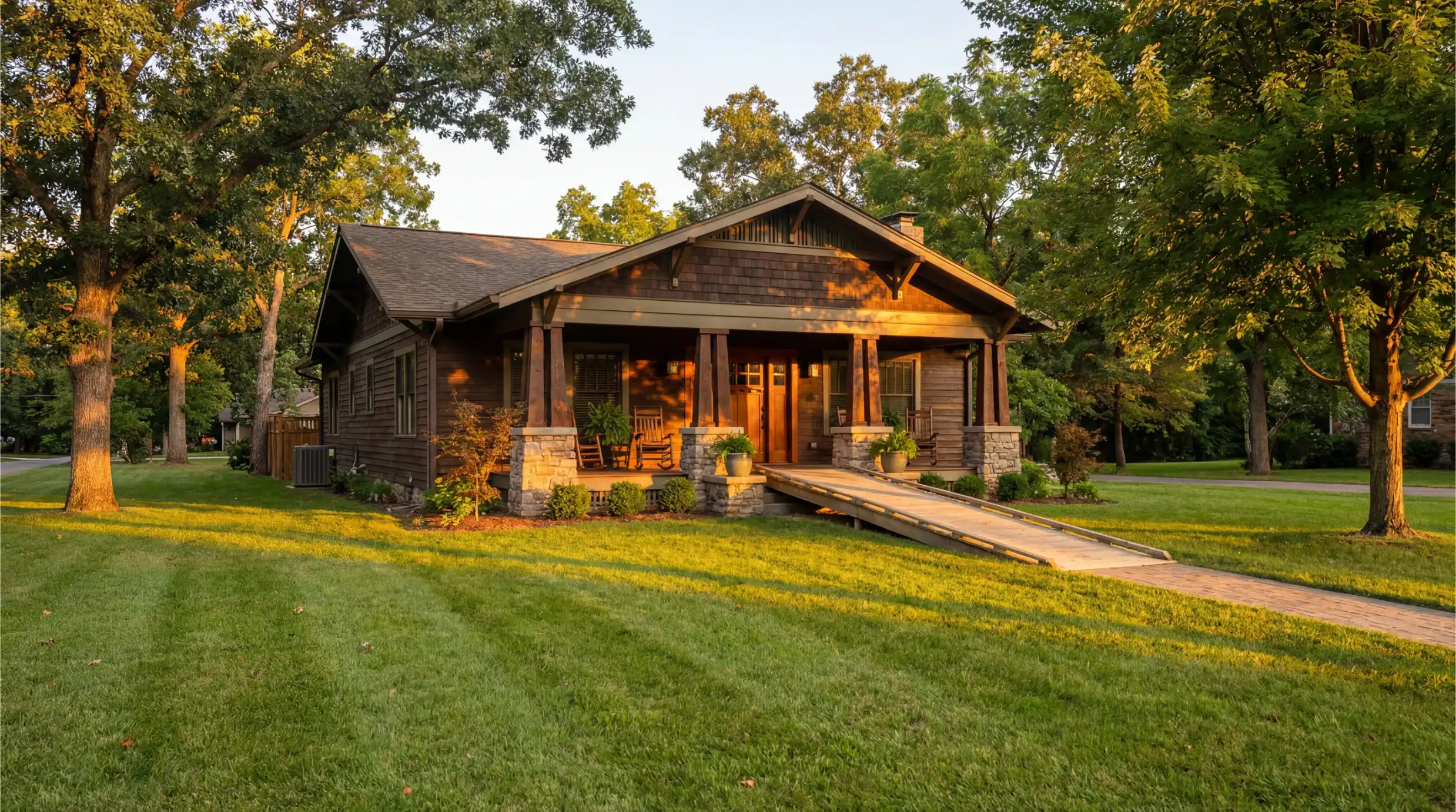
This money will allow our client to finally buy a nice home with land in Atlanta, furnish and retrofit that home for his wheelchair, purchase a vehicle equipped to transport him, pay for caregivers, and even take vacations with the help he needs.
An Incredible Human Being
Our client’s story is still heartbreaking. But here’s something that still amazes me: throughout this entire six-year ordeal, he continued going to the gym. He lifted upper body weights to the extent that he could. He is one of the most positive, determined human beings I have ever met — and he is absolutely determined to walk again.
Even though medicine doesn’t currently have a clear path for that to happen, he now has the funds to pursue cutting-edge treatments that could someday make it a reality.
Why This Semi-Truck Accident Settlement Matters — and Why Your Choice of Lawyer Matters
This case is the reason we do what we do. It’s the reason we fight when many others would stop.
The odds were stacked against us at nearly every stage. Our client was the one who rear-ended the other truck. The insurance policy was only $1 million. There were no other assets. Florida law created a massive legal presumption against us. The insurance company fought every inch of the way. And the case required strategic decisions at every turn — from choosing to withhold a demand letter, to selecting the right venue, to assembling a trial team specifically designed for a Miami courtroom.
But we kept going, kept investing, kept believing — and ultimately achieved the best possible outcome for our client.
From our Orlando office, we handle semi-truck accident cases and catastrophic injury cases throughout Florida, developing unique and aggressive strategies for every client. This semi-truck accident settlement is a perfect example of our low-volume, maximum-value approach — the kind of case that requires years of dedicated attention, significant financial investment, and lawyers who refuse to take the easy path when a client’s future is on the line.
If you or a loved one has been seriously injured in a semi-truck accident, an 18-wheeler crash, or any catastrophic accident in Orlando or anywhere in Florida, I would encourage you to think carefully about who you hire. Not every firm will fight past the policy limits. Not every firm will invest a million dollars in costs on your behalf. Not every firm will assemble a nationally recognized trial team tailored to the specific courtroom where your case will be heard. Not every firm will spend six years on a single case because it’s the right thing to do.
We will. And we have the results to prove it.
I’m eternally grateful to have the skills needed to change someone’s life in the most profound ways — to help them, to make the best out of a tragic situation. There is no perfect ending here. But there is a man who can now take life on his own terms, chart his own destiny to the extent humanly possible, and hold his head high. We were extremely honored that he trusted us — and we hope and believe that we delivered.
Want to learn more about how we maximize case value through our focused, selective approach? Call (407) 803-2139, or visit our contact page for a free consultation about your specific situation.
Past results do not guarantee future outcomes. Every case is unique and depends on its specific circumstances.
More Case Stories & Essential Reading:
He Rear-Ended Another Semi. Most Lawyers Would Have Said Take the Million. We Got Him $7 Million — And Then Kept Working.
The $7 million settlement was just the beginning. What happened next — twelve trips to Atlanta, finding the right Medicaid lien specialist, structuring a special needs trust, working with architects on an accessible home — is the part of representation almost no one ever discusses. Read what happened after our fee was already earned.
How We Turned an $11,000 Facial Scar Case Into a $1 Million Semi-Truck Settlement
The first lawyer thought this was an $11,000 case. We pushed for advanced brain imaging that uncovered a traumatic brain injury and permanent nerve damage no one had diagnosed. We recovered the full $1 million policy without ever filing suit — because we looked closer than anyone else had.
$2.75 Million Recovery After Big Orlando Law Firm Nearly Destroyed the Case
When this client came to us, the previous firm hadn’t preserved the wrecked vehicle or sent a spoliation letter to the trucking company. We stepped in weeks before critical evidence would have vanished forever. The result was $2.75 million — but the case could have been worth more if we’d been hired from day one.

Tina Willis, Orlando Personal Injury & Car Accident Lawyer
Hello! I'm Tina Willis, a serious injury, accident & wrongful death lawyer based in Orlando, Florida. I graduated second in my law school class (1997) and taught federal civil procedure & legal writing at Barry University in Orlando. Before representing injury victims, I worked for a major defense firm representing excess insurers, including Lloyd's of London, where we oversaw the work of regular insurance defense lawyers on large verdict cases. So I know their defense tactics, and what it takes to maximize car and big truck accident cases.
I work with a small group of highly experienced lawyers focused on moderate to catastrophic injury and wrongful death cases: car accidents, commercial & semi-truck crashes, medical malpractice, and slip and fall accidents. We are trial attorneys who stay accessible to our clients, and we've recovered multi-millions for clients throughout Florida.
Voted a top-three winner for Best Personal Injury Firm and Best Law Firm in Orlando Weekly's 2026 Best of Orlando readers' poll.