
If you’ve been injured in an accident in Florida, recent changes to state law could significantly impact your right to compensation. In March 2023, Florida dramatically changed how fault affects injury claims through House Bill 837. This new law could affect your ability to recover money for your medical bills, lost wages, and other damages after any car accident or truck crash.
Injury & accident lawyers throughout the state were (and still are) extremely concerned about the effect of Florida’s new so-called “tort reform” law on accident victims.

Key Changes to Florida’s Comparative Negligence Law
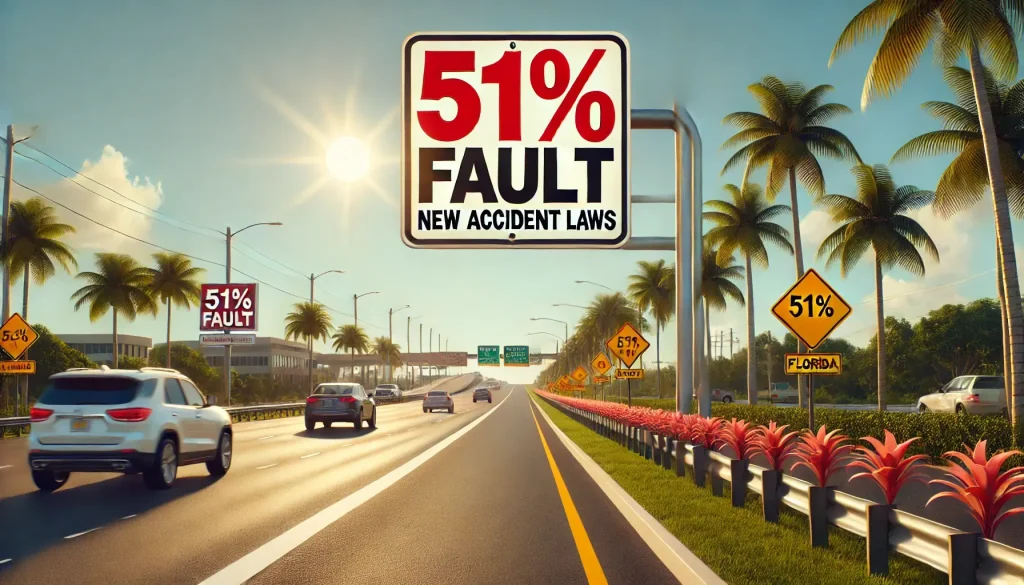
The most important change is that Florida now uses a “modified comparative negligence” system instead of “pure comparative negligence.” Under this new system, you can only recover compensation if you are 50% or less at fault for the accident. If you’re found to be even 51% responsible, you cannot recover any compensation at all. When you qualify for compensation, your award will be reduced by your percentage of fault.
Medical malpractice cases are exempt from these changes, continuing to follow the previous pure comparative negligence system.
Understanding How This Affects Your Accident Claim
Let’s look at a real-world example. Imagine you were injured in a car accident where your total damages are $100,000. Under the new law, if you’re found to be 25% at fault, you can recover $75,000 – your damages reduced by your percentage of fault. However, if you’re found to be 51% at fault, you cannot recover any compensation, regardless of how severe your injuries may be.

Important New Deadlines for Accident Victims
Florida has also shortened the time you have to file a lawsuit. You now have only 2 years to file most personal injury claims, reduced from the previous 4-year deadline. Active duty service members may have additional time, and claims filed before March 24, 2023, still follow the old rules.
Insurance Company Tactics Under the New Law
Insurance companies are already using this new law to their significant advantage. They may try to deny valid claims by arguing that you were more than 50% at fault. Some insurers are using police reports to assign blame, even though these reports are inadmissible in court as evidence of fault. They might also conduct biased investigations to increase your share of fault.
You need to understand that, in cases involving moderate to severe injuries, insurance company adjusters and defense lawyers are now “on the hunt” for evidence that can prove you shared more than 50% of the blame for your damages. They are using very unscrupulous methods and arguments to accomplish this goal. Insurance companies have been using unfair techniques since the early 1990’s. But now their strategies, which, if successful, previously only reduced case value, now have the real potential of eliminating case value. That means, among other techniques, they will try to interview you, on or off the record, to get information that they can use to formulate an argument that you were more than 50% responsible. Even if an interview is not recorded, they can use information that they learn to find other evidence to prove whatever you have told them. This can get complicated quickly, which is why you need to hire an Orlando car accident lawyer ASAP.
As a practical matter, if you arguably shared fault for the accident, this new law reduces the average case settlement, because we have to account for the fact that the jury might side with their arguments, and potentially award you zero dollars. We also have to decline many more cases, when we would have taken a chance on more questionable fault cases before. That being said, once we have accepted any new client, we fight as hard as ever to prove that our client had as little blame as possible, with clear awareness of the implications if the jury finds them greater than 50% responsible.

Protecting Your Rights After an Accident
To protect your right to compensation, document everything about your accident and seek immediate medical treatment. Avoid giving recorded statements to insurance companies or accepting quick settlement offers without understanding your rights under the new law. Given this new law gives insurance companies an easy way out of many accidents, it is more essential than ever that you have a lawyer protecting your interests from the beginning.
Types of Accidents Affected
This new law affects virtually all types of accidents in Florida, including car crashes, truck accidents, motorcycle collisions, slip and falls, and pedestrian accidents. However, medical malpractice cases remain under the old system, allowing recovery regardless of your percentage of fault (though your compensation will still be reduced by your percentage of responsibility).
Why Evidence Matters More Than Ever Under Florida’s New Law
Florida’s new 50% fault threshold has completely changed how accident victims need to approach evidence gathering. Before 2023, if an insurance company blamed you for 60% of an accident, you could still recover 40% of your damages. Now, that same 60% fault determination means you get nothing. Zero compensation. This dramatic shift means the evidence we gather in the first hours, days, and first few weeks after your accident carries more weight than ever before.
Most accident victims don’t realize that simple actions like taking photos from the wrong angle can make damage appear less severe than it actually was. Or that documenting road conditions that seem unimportant – like a partially faded line marking – could prove critical in showing the other driver had more responsibility for the accident than you did. Or, my personal favorite, an innocent statement made to the real at-fault driver, or any insurance adjuster, can really harm your case. Under the new law, these small details can be the difference between receiving fair compensation and walking away with nothing.
The Hidden Ways Insurance Companies Use Florida’s New Law Against You
Insurance companies have developed entirely new tactics since this law changed. They’re now aggressively looking for any sign you might be even slightly over 50% at fault. We’ve seen them argue that a driver who was safely checking their rearview mirror was “distracted” and therefore 51% at fault. They’ve claimed that driving exactly at the speed limit during heavy rain made a driver 51% at fault because they should have slowed down more.
These blame-shifting strategies didn’t matter as much under the old law – you would still get compensation. But now they can completely eliminate your right to recover anything. This is why your actions and words in the first few days after an accident matter more than ever before.
Understanding Your Damages Under the New System
The new law has changed not just whether you can recover damages, but how we need to present them. For example, if you delayed seeing a doctor because of cost concerns, insurance companies now argue this makes you partially at fault for your own damages – and they’ll try to push that fault percentage over 50% to avoid paying anything.
Consider this real situation: Before the new law, if you had $100,000 in medical bills and were found 60% at fault, you’d still receive $40,000 to help with those bills. Today, you would receive nothing. This means we now need to document every aspect of your medical treatment decisions to show you acted reasonably and shouldn’t bear fault for the extent of your injuries.
How Fault Percentages Affect Your Compensation
Example Scenarios:
$100,000 Total Claim Value:
- 0% your fault = $100,000 recovery
- 25% your fault = $75,000 recovery
- 40% your fault = $60,000 recovery
- 50% your fault = $50,000 recovery
- 51% your fault = $0 recovery
Critical Questions About Fault Under the New Law
When a police report places blame on you, the stakes are higher than ever before. While these reports still aren’t admissible in court, insurance companies use them aggressively to support their arguments that you’re over 50% at fault. This means we often need to conduct our own investigation as soon as possible, particularly in more serious accident cases – before skid marks fade or witnesses forget critical details.
The question of how fault percentages are determined has taken on new urgency. Insurance companies now hire specialized analysts whose sole job is finding ways to push fault just over that 50% threshold. They look at factors most people would never consider – like whether your tire pressure being slightly low made you slightly more at fault, or whether changing the channel on your radio should add to your fault total.
When dealing with uninsured drivers, the new law creates extra complications. Since you now need to prove you’re 50% or less at fault even in uninsured motorist claims, we’ve had to develop new strategies for documenting these accidents. We need to get a jump on the adjuster & defense lawyer by quickly finding ways that the other driver should bear more of the blame.
How Do Insurance Adjustors & Lawyers, Mediators & Juries Determine Fault Percentages?
Fault percentage determinations consider multiple factors:
- Traffic laws violated by each party
- Road conditions and weather
- Vehicle maintenance records
- Driver behavior and actions
- Witness statements
- Expert analysis of physical evidence
Remember, in questionable cases, initial fault determinations can be challenged with proper evidence and legal representation.
Getting Help With Your Accident Claim
Understanding how Florida’s new comparative negligence law affects your case is essential to protecting your rights. Insurance companies have always tried to shift blame to minimize what they pay. They now have a law that helps them considerably with that goal. Having experienced legal representation can help offset the damaging effect of Florida’s drastic new tort laws.
Contact us for a free consultation to discuss your accident case and understand your rights under Florida’s new law. We can help you navigate these complex legal changes and fight for the compensation you deserve.
This article was last updated October, 2024. The information provided is for general informational purposes only and should not be considered legal advice.

Tina Willis, Orlando Personal Injury & Car Accident Lawyer
Hello! I'm Tina Willis, a serious injury, accident & wrongful death lawyer based in Orlando, Florida. I graduated second in my law school class (1997) and taught federal civil procedure & legal writing at Barry University in Orlando. Before representing injury victims, I worked for a major defense firm representing excess insurers, including Lloyd's of London, where we oversaw the work of regular insurance defense lawyers on large verdict cases. So I know their defense tactics, and what it takes to maximize car and big truck accident cases.
I work with a small group of highly experienced lawyers focused on moderate to catastrophic injury and wrongful death cases: car accidents, commercial & semi-truck crashes, medical malpractice, and slip and fall accidents. We are trial attorneys who stay accessible to our clients, and we've recovered multi-millions for clients throughout Florida.
Voted a top-three winner for Best Personal Injury Firm and Best Law Firm in Orlando Weekly's 2026 Best of Orlando readers' poll.